

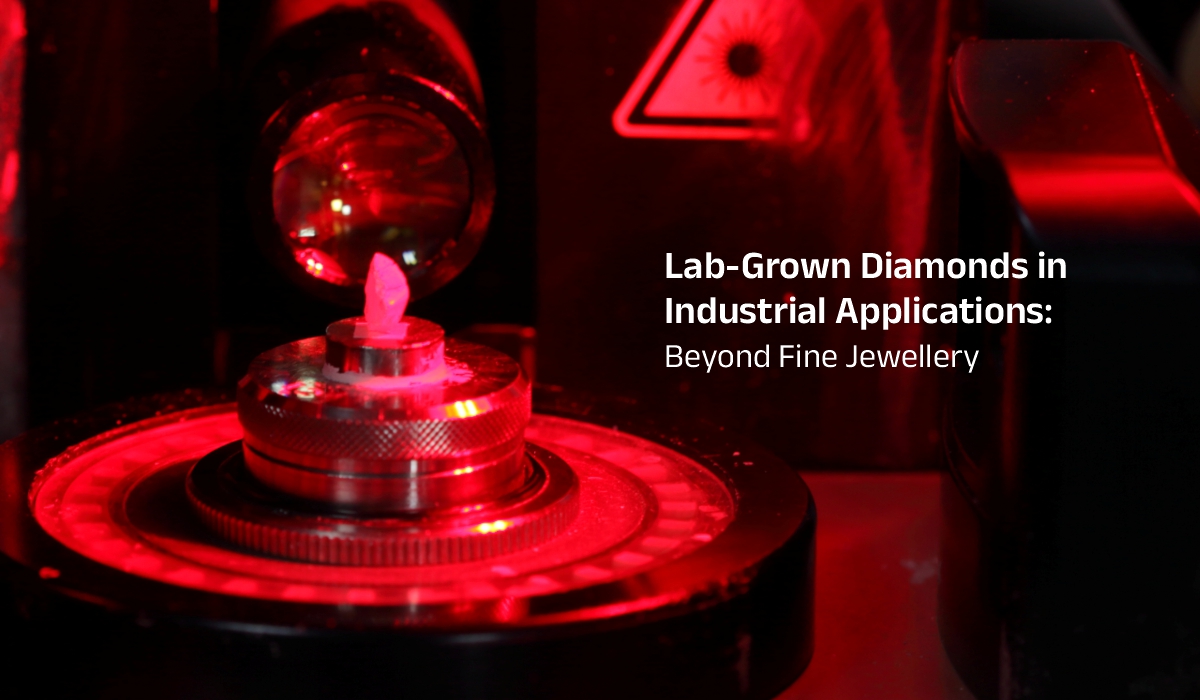
Laboratory-Grown Diamonds in Industrial Applications: Beyond Fine Jewellery
Diamonds have always been the epitome of luxury, beauty, and exclusivity. But that should not dissuade you from believing in the fact that their value extends beyond the world of sparkle. Their incredible chemical, thermal, and optical properties make them a valuable option for various industrial sectors. With state-of-the-art technologies, laboratory-grown diamonds have emerged as […]
Diamonds have always been the epitome of luxury, beauty, and exclusivity. But that should not dissuade you from believing in the fact that their value extends beyond the world of sparkle. Their incredible chemical, thermal, and optical properties make them a valuable option for various industrial sectors. With state-of-the-art technologies, laboratory-grown diamonds have emerged as a cost-effective alternative to diamonds.
In this article, we will learn about the industrial applications of laboratory-grown diamonds. But first, let us understand what they are.
What Are Laboratory-grown Diamonds?
Laboratory-grown diamonds are beautiful and hard man-made sparklers. They are created in a controlled environment in laboratories using advanced technologies. Their formation process replicates that of the natural diamonds. Both natural and laboratory-grown diamonds have the same optical, physical, and chemical properties.
Because they are each other’s indistinguishable mirror-images, only an experienced jeweller can tell them apart. Today, the versatile industrial applications of laboratory-grown diamonds are making the headlines. One of the biggest reasons why people are more inclined toward choosing these stones instead of their natural counterparts is because they don’t come with a hefty price tag like the latter ones. Now, let’s learn about them.
Cutting, Grinding, & Drilling
Did you know laboratory-grown diamonds score the perfect 10 on the Mohs scale of hardness as natural diamonds? Well, yes, you read that right. That’s why three of the most popular industrial applications of laboratory-grown diamonds are cutting, grinding, and drilling.
The exceptional hardness of these stones makes them perfect for processing substances that conventional cutting tools cannot handle. Laboratory-grown diamond industrial applications range from manufacturing diamond-tipped saw blades and grinding wheels to polishing compounds.
Such tools are used in various industries, such as construction and infrastructure, automotive manufacturing, and stone and ceramic processing, to name a few.
Advanced Electronics Industry
The next on our list of industrial applications of laboratory-grown diamonds are advanced electronics and semiconductor technology. Today, electronic devices have become much smaller, faster, and more powerful than they were back in the days. As a result, conventional semiconductor materials struggle to dissipate heat effectively in high-performance applications.
That’s where laboratory-grown diamond innovation comes into picture. Because laboratory-grown diamonds offer excellent thermal conductivity as natural diamonds, they make a suitable option for thermal management in electronic systems.
From semiconductor heat spreaders and high-power electronic devices to advanced power electronics, laboratory-grown diamonds offer a variety of use cases.
Medical & Healthcare Applications
Among the various industrial applications of laboratory-grown diamonds are specialised medical and scientific equipment. Laboratory-grown diamonds have considerable potential when it comes to the medical industry thanks to their hardness, chemical stability, and biocompatibility in suitable forms.
The potential applications include medical imaging components, precision surgical instruments, and biomedical sensors, to name a few. Diamond-coated surgical and dental instruments can provide excellent cutting performance and resistance to wear.
Another emerging area is the use of laboratory-grown diamonds in biomedical sensing. Specifically engineered diamonds with nitrogen-vacancy (NV) centres have unique optical and magnetic properties that allow researchers to investigate highly sensitive quantum sensing technologies.
Aerospace and Automotive Industries
Certain industries, such as aerospace, automotive, and defence, operate under extreme conditions. Such industries require materials capable of maintaining performance under high temperatures, pressure, and friction. And laboratory-grown diamonds offer several properties that make them perfect for them.
Some of the most popular industrial applications of laboratory-grown diamonds include precision machining of engine components in the automotive industry and specialised optical systems in aerospace engineering.
Optical and Laser Technology
Last but not least on our list of industrial applications of laboratory-grown diamonds are optical applications. Because laboratory-grown diamonds possess excellent optical properties, they are extremely useful in specialised optical applications. From high-power laser windows and infrared optical systems to laser heat management, the applications are several.
Diamond’s combination of optical transparency, thermal conductivity, and mechanical strength makes it a suitable option for demanding environments where conventional optical materials may experience overheating or mechanical damage.
Conclusion
Today, the applications of laboratory-grown diamonds are not limited to jewellery. Their growing role in industrial applications of laboratory-grown diamonds highlights their importance across some of the most technologically advanced industries, from advanced electronics to medical and healthcare.
Their exceptional hardness, thermal conductivity, optical performance, and chemical stability make them suitable for applications ranging from industrial cutting tools and semiconductor technology to medical equipment, aerospace engineering, and quantum research.
Ultimately, the real value of lab-grown diamonds lies not only in their brilliance but also in their ability to drive progress across different sectors.
FAQ
- What are laboratory-grown diamonds used for in industrial applications?
The industrial applications of laboratory-grown diamonds include everything from cutting tools, drilling equipment, and semiconductors to heat spreaders and medical instruments.
- How hard are laboratory-grown diamonds?
Laboratory-grown diamonds are exceptionally hard just like the natural ones. They score a perfect 10 on the 10-point Mohs scale of hardness.
- What makes laboratory-grown diamonds suitable for industrial use?
Laboratory-grown diamonds are preferred for industrial use because they offer consistent quality, controlled production, and customisation possibilities.
- Are laboratory-grown diamonds sustainable?
Though laboratory-grown diamonds are considerably sustainable because they are not mined, their environmental impact depends on electricity sources and manufacturing efficiency.
- Can laboratory-grown diamonds withstand high temperatures?
Yes, laboratory-grown diamonds can withstand high temperatures because they possess excellent thermal stability and conductivity.