

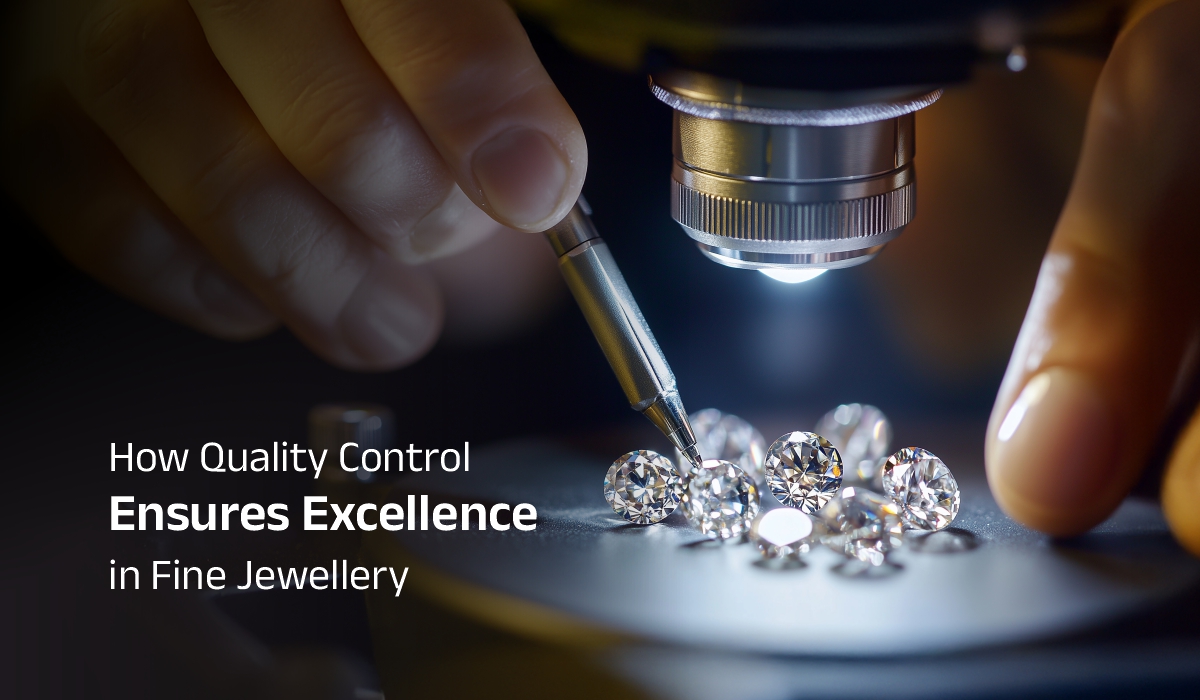
How Quality Control Ensures Excellence in Fine Jewellery
Did you ever wonder what goes behind creating a fine jewellery piece? From selecting a design and deciding on the diamonds to casting and polishing, there are various steps involved in crafting jewellery. But one thing that stays common in all the steps is jewellery quality control. Quality control is of utmost importance when it […]
Did you ever wonder what goes behind creating a fine jewellery piece? From selecting a design and deciding on the diamonds to casting and polishing, there are various steps involved in crafting jewellery. But one thing that stays common in all the steps is jewellery quality control.
Quality control is of utmost importance when it comes to creating jewellery that’s valued for its design, craftsmanship, and finish. It helps identify potential problems at each step, ensuring that the final piece meets industry-leading jewellery manufacturing standards.
Visual appeal, precision, durability, and overall finish are a few parameters that stand as the basis of jewellery quality control. Before further ado, let’s explore how it ensures excellence in fine jewellery.
Examining Raw Materials
The first and foremost step in quality control is inspecting the raw materials. All elements of a jewellery piece are thoughtfully examined, such as diamonds, colour gemstones, accent stones, and the metal.
Manufacturers need to verify that the purity of the metals meets the specific requirement of the jewellery piece. Similarly, they need to choose diamonds and gemstones based on the required cut, shape, clarity, carat weight, and dimensions. The quality and grading factors of stones are verified through their relevant certificates.
Precision jewellery quality control maintains consistency across a collection.
Reviewing Jewellery Designs
After the design of the jewellery piece is selected, it is reviewed using a CAD rendering. CAD or Computer-aided design helps manufacturers understand the different aspects of the jewellery piece, from the centrestone and the accent stones to the prongs.
Each of the aspects is closely examined to identify issues that might otherwise lead to defects or imperfections in the piece. For instance, using the CAD rendering, manufactures can check whether the dimension of the setting is perfect so as to hold the centrestone secure in its place.
Sometimes adjustments need to be done to the setting. Jewellery quality control works wonders in examining proportions.
Maintaining Accuracy
Jewellery manufacturing demands accuracy at every stage, from casting to setting the stones and laser cutting. Jewellery quality control helps in maintaining accuracy at every stage. For instance, manufacturers thoughtfully inspect pieces for defects during the casting stage, checking for incomplete sections or unwanted porosity.
During assembly, manufacturers check whether the elements perfectly fit together. Even a small variation from the actual design compared to the design can affect the visual appeal of the jewellery piece.
Checking Surface Finish
Another step in jewellery quality control is inspecting the surface finish and polishing of the jewellery piece. This is not just about making sure that the metal shines perfectly. In addition to that, it is about ensuring that the finish remains consistent throughout the piece.
Are the edges smooth? Are there any dents, scratches, or uneven surfaces on the piece? Or, are there any visible soldering joints? Manufacturers find answers to questions like these in order to make certain that the finished piece meets the intended design standard.
Final Quality Inspection
In the last stage of jewellery quality control, the jewellery piece undergoes a final inspection that is a culmination of all the previous checks. Before the jewellery piece is dispatched, manufacturers check it under different lighting conditions and magnification to ensure that every detail is as flawless as possible.
Clasps, prongs, and fastenings are checked wherever relevant. Pieces with intricate settings are checked for visual defects that might otherwise go unnoticed by the wearer. If any issue is found during the final inspection, the piece is sent back for correction and then reinspection.
There is no denying that the jewellery quality control process is nothing short of a responsibility that should never be taken lightly.
Conclusion
From choosing quality diamonds to the final inspection, each stage of jewellery quality control requires utmost care. Indeed, the beauty of a finished jewellery piece is a combination of the artisans’ skilled craftsmanship and the manufacturer’s careful inspection.
So, the next time you hold a luxury jewellery piece, don’t forget to appreciate the precision that went into creating it.
FAQ
- What’s jewellery quality control?
Jewellery quality control is the process of carefully inspecting each element of a jewellery piece to ensure every detail is flawlessly finished.
- During which stage of jewellery manufacturing is quality control performed?
Quality control is performed at every stage of the jewellery manufacturing process, from raw materials to polishing.
- What’s the significance of jewellery quality control?
Jewellery quality control holds utmost significance because it helps manufacturers identify potential defects, maintain consistent craftsmanship, and uphold their brand’s quality standards.
- Does CAD help in quality control?
Yes! CAD plays a crucial role in quality control, helping manufacturers inspect every aspect of a jewellery design in detail before production.
- How do manufacturers ensure gemstones are securely set?
They can do so by inspecting the setting, checking the alignment of each stone and examining prongs, bezels or other holding components. Suitable checks help identify loose stones and setting defects.