

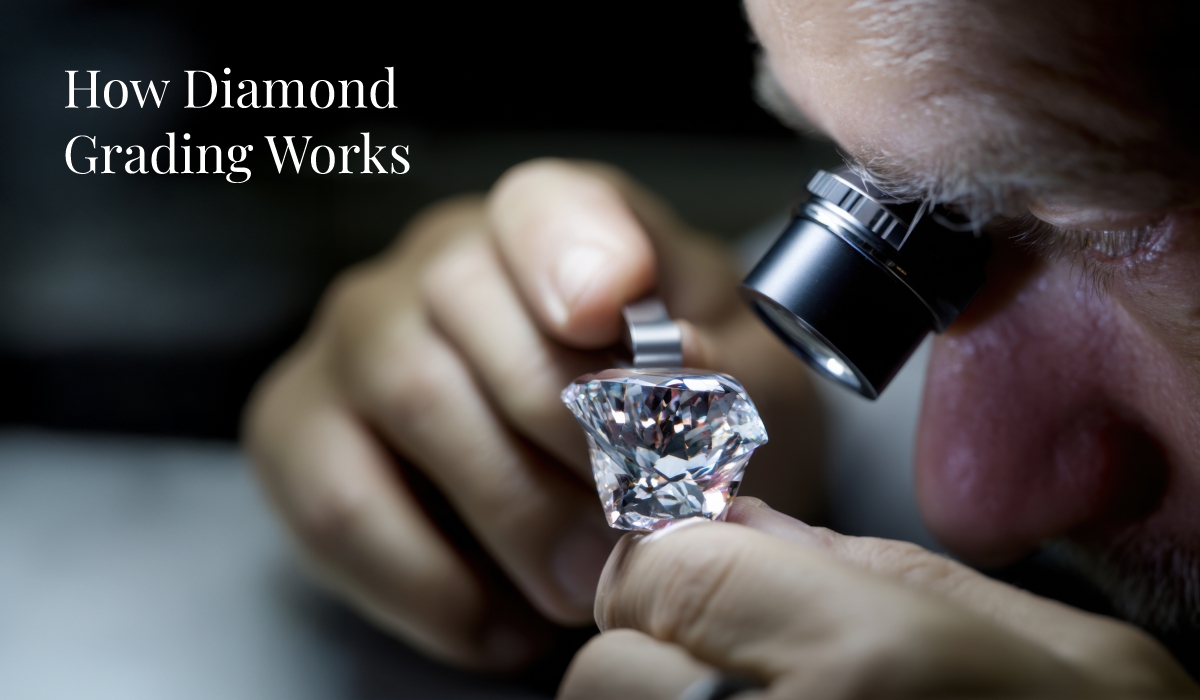
How Diamond Grading Works
So, you’ve finally decided to treat yourself to sparkling jewellery, and you want to learn about diamond grading. Fair enough. An informed purchase always hits the mark. When you buy a diamond jewellery piece, you come across terms such as colour, cut, clarity, and grade, to name a few. These are not just mere features […]
So, you’ve finally decided to treat yourself to sparkling jewellery, and you want to learn about diamond grading. Fair enough. An informed purchase always hits the mark.
When you buy a diamond jewellery piece, you come across terms such as colour, cut, clarity, and grade, to name a few. These are not just mere features but crucial elements that altogether play an integral part in determining the value of a diamond. Diamond grading is all about them.
What Is Diamond Grading?
Diamond grading, as the name suggests, is a process through which diamonds are graded based on their characteristics. In this process, diamonds are first examined by an experienced gemmologist, and then the metrics of their elements are recorded in a grading report.
The gemmologist uses specialised equipment such as a 10x loupe, gem microscope, and electronic carat balance, etc. to assess every diamond. The documented information in the report created by the grader stands as the ultimate source or tool delineating the quality and characteristics of the diamond.
Grading Factors
There are four main diamond quality and grading factors that a trained gemmologist assesses: colour, clarity, cut, and carat weight. Each of these factors contributes significantly when it comes to setting the price of the stone. Let’s take a closer look at them to understand how diamond grading works.
Colour
Diamonds are incredible creations of nature and time. Their formation deep within the earth’s surface takes more than a million years. All this time, nature’s extreme heat and pressure influence the chemical composition of diamonds.
As a result, some diamonds appear completely colourless, some showcasing a hint of brown or yellow, while a few end up coloured.
In colourless diamonds, colour, as a diamond grading factor, refers to the absence of colour in the stone. The more colourless the stone, the higher its price, of course, assuming the other factors are equivalent in terms of quality.
This factor is measured on GIA’s D to Z diamond colour grading scale. The scale begins with D, representing extremely colourless stones, leading all the way to grade Z, which represents stones displaying a hint of brown or yellow. Colour grading is done in a controlled environment because lighting and surroundings can influence the colour of a stone.
Clarity
After examining the colour of a diamond, the gemmologist then assesses its clarity. Clarity refers to the absence of inclusions or visual imperfections in the stone.
During the formation of natural diamonds, mineral crystals, tiny pockets of fluid or gas, internal cracks, feathers, and other such imperfections get trapped inside the stones. These natural imperfections, or inclusions, influence the appearance of diamonds.
Because diamonds generally have inclusions, the flawless ones, or those with no visual imperfections when viewed under 10x magnification, are typically considered rarer. The clarity of diamonds is ascertained based on the GIA Clarity Scale that contains 11 grades, ranging from Flawless (FL) to Included (I1, I2, and I3).
Cut
Diamonds are renowned and coveted worldwide because of their brilliance, fire, and scintillation. While brilliance refers to how a diamond reflects light, fire emphasises the stone’s ability to disperse light into the colours of the spectrum. The light and dark areas that you see in a diamond during its interplay with light is called scintillation.
In the diamond grading process, the cut of a stone is assessed based on the GIA Cut Scale that has five grades: Excellent (EX), Very Good (VG), Good (G), Fair (F), and Poor (P). This is done by examining seven components: brilliance, fire, scintillation, weight ratio, durability, polish, and symmetry.
Uninformed buyers typically confuse the cut of a diamond with its shape. However, these are two different things that hold great significance in the diamond, gemstone, and jewellery world. While the cut of a diamond refers to its arrangement of facets, the shape refers to the stone’s outline. For instance, round, oval, marquise, and pear, to name a few, are shapes of a diamond, while round brilliant and mixed are cuts.
Carat Weight
The weight of a diamond and gemstones are measured in metric carats, with a carat weighing 0.2 grams. The carat is divided into 100 points, which means a 50-point diamond weighs 0.50 carats. Two diamonds of the same carat weight can fetch different values depending on the other diamond grading factors.
The Grading Report
Apart from the colour, cut, clarity, and carat weight, trained gemmologists include some other aspects of diamonds in order to prepare the diamond grading report. These include proportions, measurements, and fluorescence, etc.
What’s the Significance of Diamond Grading?
Diamond grading holds utmost significance because it’s the basis of determining the value of stones. It’s also important because it helps buyers understand the specifications of diamonds such as their colour, cut, clarity, etc. A diamond grading report works wonders for buyers when it comes to comparing two diamonds of a similar appearance.
Conclusion
Diamond grading is a structured process in which diamonds are assessed based on their characteristics. The diamond grading report prepared by gemmologists gives buyers a standardised way to understand and compare diamonds.
Knowing the grading process and understanding the grading report helps buyers make an informed buying decision. So, now that you know how diamond grading works, you’re ready to shop for a diamond jewellery piece for yourself!
FAQs
- Which factors influence the price of a diamond?
There are several factors that influence the price of a diamond, including its colour, cut, clarity, and carat weight.
- Why should people buy certified diamonds?
People should buy certified diamonds because they come with an independent documentation of their characteristics, enabling buyers to make an informed purchase that fits their budget and preference.
- What are the 4Cs of diamond grading?
The 4Cs are diamond grading factors that altogether influence the value of diamonds. They comprise a diamond’s cut, colour, clarity, and carat weight.
- Who grades diamonds?
Diamonds are graded by trained gemmologists at specialised gemmological laboratories.
- How is the colour of a diamond graded?
The colour of a diamond is graded on GIA’s D-to-Z colour grading scale. On this scale, diamonds graded D are Flawless (FL), while the Z ones display hints of yellow and brown.