

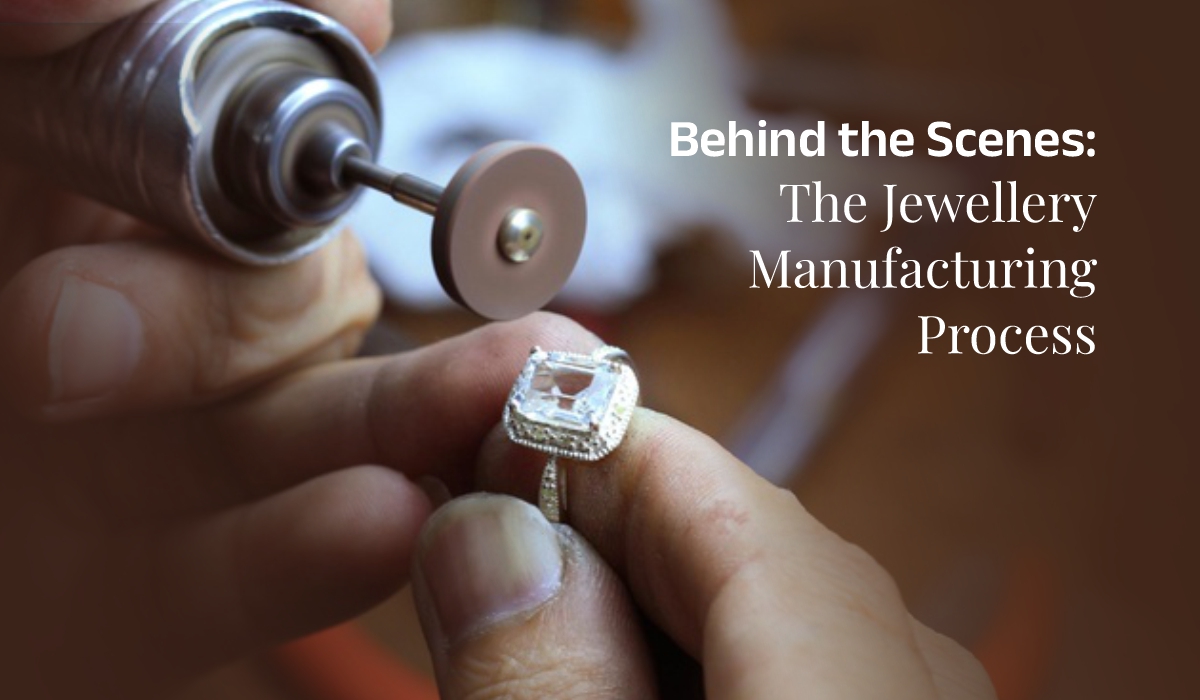
Behind the Scenes: The Jewellery Manufacturing Process
Crafting jewellery involves thoughtful consideration and technical skills. Did you ever hold a jewellery piece and think about what all went into creating it? If so, we’re here to help you understand a modern jewellery manufacturing process. It showcases a combination of creativity and technology that most manufacturers use today to bring innovative jewellery designs […]
Crafting jewellery involves thoughtful consideration and technical skills. Did you ever hold a jewellery piece and think about what all went into creating it? If so, we’re here to help you understand a modern jewellery manufacturing process. It showcases a combination of creativity and technology that most manufacturers use today to bring innovative jewellery designs to life. Without further ado, let’s dive right into the process.
Design Concept
Every jewellery piece that’s ever been created was first a design. It was a mere idea or concept that came into the mind of the designer or creative director or a customer who simply wanted a customised piece.
The jewellery manufacturing process starts with contemplating about or deciding on a design. Usually, designers who conceptualise a design take inspiration from their personal experiences, nature, art, or architecture.
They create the design of the jewellery piece on paper through sketching. Once designers finalise the design, they create its CAD rendering. CAD or computer-aided design is a technology that creators use to develop, analyse, modify, or optimise a design.
The technology has taken over the world of jewellery production by storm. A 3D CAD rendering of a jewellery piece visualises all its aspects, including the dimensions, stone sizes and proportions, curves and contours, and setting structures.
What’ll be the thickness of the jewellery piece? How will the centre stone sit within it? The three-dimensional model gives you answers to such questions. There’s no denying that CAD has significantly simplified the jewellery manufacturing process.
A Physical Version
Once the CAD rendering is ready, it is turned into a physical prototype of the jewellery piece. Modern jewellery manufacturers use 3D printers to create a wax or resin model that replicates the digital design.
Converting the CAD design into a 3D wax or resin model is especially helpful when the jewellery piece in question features an intricate design. The model makes it easier to inspect whether all aspects of the piece are accurately represented based on the design concept.
This stage is the first time in the jewellery manufacturing process that the designer sees a physical version of their jewellery.
Casting & Investment
The next step in the gemstone or diamond jewellery manufacturing journey involves placing the physical 3D model inside a casting flask. Generally, manufacturers use a perforated casting flask or metal container to hold the pattern.
Then, the model is surrounded by a heat-resistant investment material that creates a mould around it. Also known as investment slurry, the investment material is created by mixing a plaster-like substance with water.
Before moving on to the next step in the jewellery manufacturing process, the investment material is given time to change from a liquid to a solid.
Investment Mould & Casting
Once the investment material has hardened, the metal container is then subjected to intense heat in a furnace. The heat causes the wax or resin 3D model to melt and burn out from the inside of the hard investment material.
As a result, an empty cavity in the investment material is created in exactly the same shape as the 3D model. This is where metal comes into play. The designer’s chosen metal is to be introduced into the cavity.
However, as per the jewellery manufacturing process, that’s done after the investment mould is brought to the desired temperature and the metal is heated until it melts. Once the molten metal inside the cavity cools off and solidifies, the investment material is removed, revealing the cast form of the jewellery piece.
Casting Cleaning & Refining
The cast form of the piece features excess metal, unwanted marks or imperfections, and rough edges. Now, the manufacturer relies on the expertise of their skilled workforce to remove excess metal and refine the metal casting to bring it closer to the intended design.
Setting the Stones
At this stage, stones are carefully positioned and secured in the jewellery piece. This is a highly precise work that requires deep concentration and thoughtful consideration. If the design of the piece is intricate, artisans perform the task of securing the stones in place under magnification. In some jewellery manufacturing processes, different types of stone settings are required, such as prong, bezel, channel, and bead, to name a few.
Laser Cutting & Soldering
If the jewellery piece features elements such as separate heads and shanks, connecting links, a backing, or a post, then these components need to be assembled to form the final piece.
This process is carried out through laser cutting and soldering based on the design of the piece and the manufacturing setup. Today’s jewellery manufacturers use both traditional and modern techniques to assemble these elements.
Polishing & Plating
Polishing and plating are the two crucial aspects of the jewellery manufacturing process that make a piece a sight for sore eyes. While polishing involves removing surface imperfections and achieving the desired finish, plating is an additional surface treatment in which a thin layer of one metal is applied over another to improve the piece’s appearance.
Quality Control
Once polishing and plating are done, the next step in the jewellery manufacturing process is to subject the piece to quality control. This is the stage that determines whether the piece is ready to reach the customer. Here, rigorous quality checks are carried out to ensure that every element of the jewellery reflects the design concept.
Final Words
Crafting jewellery is a work of art that involves various intricate stages. In this jewellery manufacturing guide, we explored one of the most widely used processes that blends creativity with technology. Now that you’ve understood the technicalities that go behind making jewellery, don’t forget to appreciate the craftsmanship next time a piece catches your attention.
FAQs
- What is the significance of CAD rendering in jewellery?
CAD rendering plays a crucial role in designing and creating jewellery. It brings the designer’s design to life through a detailed digital representation of the piece.
- How long does it take to craft a jewellery piece?
The time required to create a jewellery piece depends on its design. Usually, a simple piece requires less time, while an intricate one may take considerably longer.
- Why is 3D printing used in jewellery manufacturing process?
3D printing works wonders when it comes to turning the design concept into reality by creating a physical wax or resin pattern.
- What happens to the wax or resin 3D model of the jewellery piece?
The wax or resin 3D model is melted and burnt out during the burnout stage, leaving a cavity in the hardened investment material for the molten metal.
- Why is quality control important in jewellery manufacturing?
Quality control is an important part of the jewellery manufacturing process because it ensures that the final piece closely matches the intended design.